Peak

Is remote work suitable for all business sectors in Saudi Arabia?

Amid the rapid changes shaping today’s world, remote work has emerged as one of the defining features of the modern workplace. Driven by digital technologies, it enables employees to perform their duties away from traditional offices. What was once seen as a temporary solution has evolved into a strategic approach that promotes greater flexibility and helps employees achieve a healthier work–life balance.

In Saudi Arabia, remote work has gained significant momentum as part of Vision 2030, which aims to advance digital transformation and strengthen the national economy—especially after the COVID-19 experience proved the effectiveness of this model, making it the preferred choice for many organizations.

The Key Business Sectors in Saudi Arabia in 2025

Saudi Arabia boasts a diversified economy that spans a wide range of business sectors, all contributing to the Kingdom’s GDP and advancing the goals of Vision 2030. From the services sector, which encompasses financial, commercial, and consulting activities, to the industrial sector driven by oil, petrochemicals, and manufacturing, the nation’s economic foundation is broad and dynamic. The technology sector is witnessing rapid growth supported by ongoing digital transformation efforts, while the healthcare sector plays a vital role in meeting community needs and improving quality of life. The education sector focuses on preparing skilled talent capable of leading the future, and the construction sector serves as a cornerstone for infrastructure development and urban expansion. Meanwhile, the hospitality and tourism sector continues to flourish as Saudi Arabia strengthens its position as a leading global destination.

Although all these sectors work collectively toward achieving sustainable development goals, their nature and operational requirements vary widely. The technology sector thrives on innovation and flexible work environments, while the healthcare sector demands consistent on-site presence and high precision. The education sector emphasizes both direct and virtual engagement with learners, whereas the construction sector relies heavily on fieldwork and collaboration among diverse teams.

This diversity in work dynamics highlights the inclusiveness and resilience of the Saudi economy—its ability to adapt, evolve, and thrive amid global transformations.

Saudi Business Sectors Best Suited for Remote Work

With the advancement of technology and the growing adoption of flexible work models, several sectors in Saudi Arabia have emerged as ideal options for remote work. Their tasks can be efficiently performed online without the need for traditional office attendance. Among the most prominent sectors are:


1. Information Technology and Programming
This is one of the most suitable fields for remote work, as its tasks rely primarily on computers and the internet. It includes software development, information systems management, and data analysis.

2. Digital Marketing and Media
This sector covers online advertising campaigns, social media marketing, and digital performance analysis — all of which can be effectively carried out remotely.

3. Customer Service and Technical Support
Customer service and technical support teams can operate through digital communication channels and online chat platforms, allowing services to be delivered efficiently from anywhere.

4. Graphic and Creative Design
Designers and creative professionals rely on modern design software to complete their projects, making their work naturally well-suited to remote environments.

5. Education and E-Learning
This field allows teachers and trainers to deliver lessons and courses through e-learning platforms, easily engaging with students in virtual classrooms.

6. Consulting and Administrative Services
This includes preparing reports, strategic planning, and overseeing administrative operations using digital collaboration tools — significantly reducing the need for on-site presence.

Sectors Less Suitable for Remote Work in Saudi Arabia


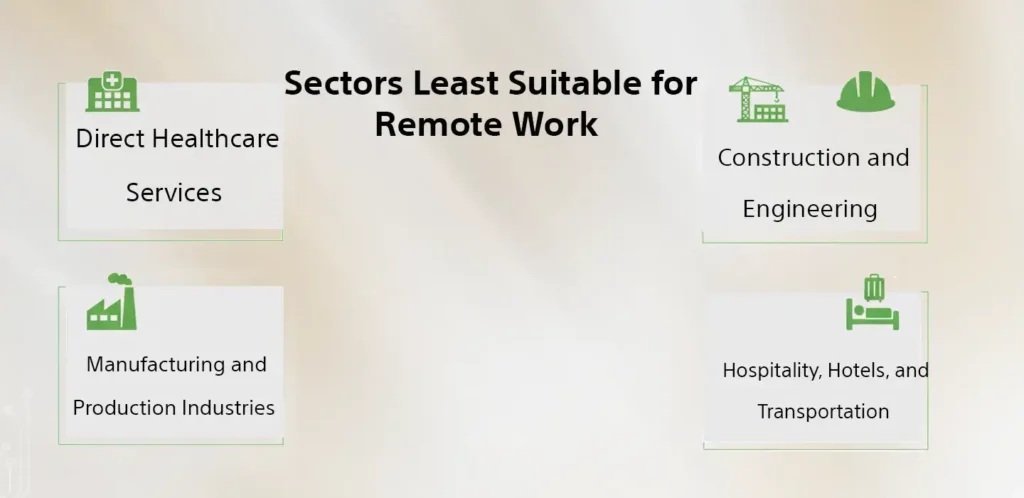
The sectors least suitable for remote work in Saudi Arabia include direct healthcare construction, manufacturing, hospitality, and transportation


Despite the growing adoption of flexible work models across Saudi business sectors, some fields still require a strong on-site presence due to the operational and service-based nature of their work, which makes remote execution challenging. The most notable among these sectors include:


1. Direct Healthcare Services
This sector relies heavily on in-person interaction with patients — from examinations to medical care — making physical presence within healthcare facilities indispensable.


2. Manufacturing and Production Industries
These industries require workers to be physically present on factory floors and production lines to operate machinery, monitor quality, and ensure smooth processes. As a result, remote work remains largely impractical in this vital field.


3. Construction and Field Engineering
Among the most field-dependent professions, this sector demands constant supervision of construction sites and coordination among multiple teams, leaving little room for remote work.


4. Hospitality, Tourism, and Transportation
These service-oriented sectors depend on direct, in-person interaction with customers to deliver a complete experience. Consequently, remote work is limited to a few administrative or marketing roles within these industries.

Criteria for Determining Whether Remote Work Is Suitable for a Sector


To make remote work an effective option in any sector, several fundamental criteria must be taken into account:

1. Nature of Tasks and On-Site Requirements
The more a job depends on analysis, management, or creative thinking rather than hands-on, physical execution, the easier it is to adapt it to a remote work model. Conversely, sectors that require a strong physical presence — such as healthcare or construction — are generally less suitable.

2. Level of Technological Adoption and Communication Tools
Professions that rely heavily on computers, software systems, and digital collaboration platforms are strong candidates for remote work. In contrast, roles that lack technological support may face challenges in transitioning to this model.

3. Company Policies and Regulatory Environment
The feasibility of remote work varies from one organization to another, depending on internal policies, management flexibility, and the overall legal framework governing labor practices and work arrangements.

4. Readiness of Technical Infrastructure
A successful remote work environment requires a reliable internet connection, secure data management systems, and effective communication platforms. Thus, the level of infrastructure readiness is a key factor in ensuring the success of remote work implementation.

Challenges and Opportunities of Remote Work in Saudi Arabia’s Business Sectors

As remote work continues to gain momentum across Saudi Arabia, a range of challenges and opportunities have emerged—each varying in intensity and impact depending on the sector and size of the organization.

1. Technical and Organizational Challenges

  • Weakened direct communication among employees can affect teamwork, collaboration, and overall cohesion.
  • Difficulty in monitoring performance and measuring productivity while maintaining accountability and discipline.
  • Technical obstacles, such as unstable internet connections, data security risks, and the growing need for advanced cybersecurity systems.
  • Psychological and social challenges, including isolation and reduced motivation, can disrupt the balance between work and personal life.

2. Opportunities: Cost Reduction and Greater Flexibility

  • Lower operational costs by reducing expenses on office spaces, utilities, and physical resources.
  • Saving time and resources previously spent on commuting.
  • Empowering employees to work more flexibly according to their individual circumstances, enhancing job satisfaction and loyalty.
  • Potential productivity boost through a more comfortable and adaptable work environment.

3. Impact on Saudization and National Policies

  • Supporting Saudization efforts by enabling citizens to work from anywhere, especially those in remote or underserved regions.
  • Advancing Vision 2030 objectives through digital transformation and greater participation of the national workforce.
  • Upskilling Saudi professionals in emerging fields such as technology, digital marketing, and data-driven industries.
  • Modernizing regulatory frameworks to safeguard the rights of remote workers, ensure performance accountability, and strengthen cybersecurity measures.

These challenges and opportunities differ across sectors: while technology-driven industries can easily adopt remote work, fields like healthcare or construction face greater limitations due to the need for on-site operations. Therefore, achieving success in remote work requires sector-specific strategies, thoughtful management of remote teams, and a strong focus on effective communication and performance optimization.
 

Remote work represents one of the most significant shifts in modern employment models. However, its effectiveness is not uniform across all sectors. While it offers vast opportunities for growth in knowledge-based, technological, and creative fields, its implementation remains more complex in sectors that require a strong on-site presence, such as healthcare and construction.

Therefore, assessing the suitability of remote work should be based on several key factors — including the nature of tasks, sector-specific requirements, readiness of technological infrastructure, and the regulatory framework that supports its application.

Ultimately, remote work is not a complete substitute for traditional models, but rather a strategic option that can be flexibly integrated in alignment with each sector’s needs and the Kingdom’s broader national development goals.