Fundamentals of Performance Management: Your Path to Excellence
The fundamentals of performance management are the true driver of any organization’s growth. They go beyond routine procedures, serving as a strategic process designed to enhance employee performance and align their efforts with the company’s overarching vision.
In this guide, we’ll show you how to implement a comprehensive performance management system that ensures higher efficiency and productivity.
What is Performance Management?
Performance management is a continuous lifecycle that begins with planning and culminates in development. It’s the tool that allows you to measure organizational performance by evaluating each individual’s contribution.
Remember: an annual review offers a “look into the past,” whereas a modern performance management system serves as a “roadmap for the future.”
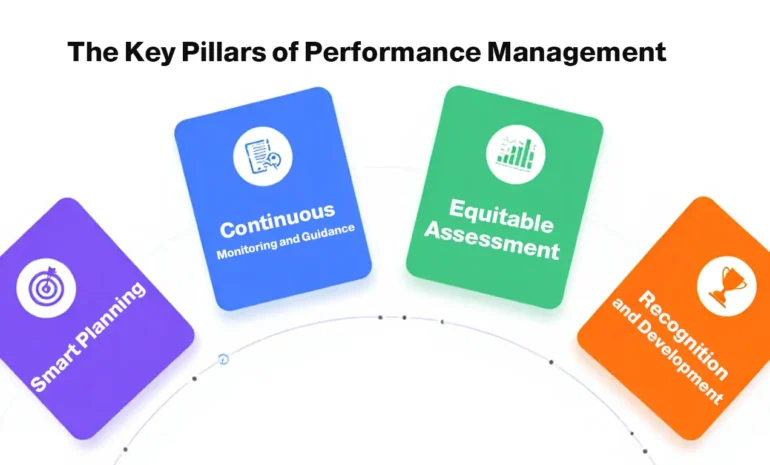
The Four Key Components of an Effective Performance Management System
1. Smart Planning: Mapping the Path to Success with SMART Goals
The first fundamental of performance management is clearly defining what each employee is expected to achieve. Use the SMART goal methodology to ensure complete clarity.
Practical example: Instead of saying, “We want to increase production,” set the goal as: “Increase completed transactions by 20% in Q3.”
2. Monitoring and Coaching: How 1:1 Sessions Drive Continuous Performance Management
Ongoing communication is the heart of the process, ensuring employees’ performance improves in real time.
Professional scenario: During coaching meetings, focus on problem-solving: “I’ve noticed a slowdown in your work pace recently. What challenges can I help you overcome to get back to your usual high performance?”
3. Fair Evaluation: When Numbers Speak Louder Than Opinions
A successful performance management system relies on key performance indicators (KPIs) rather than personal feelings. When decisions are data-driven, employees feel treated fairly, personal biases disappear, and organizational performance can be measured accurately.
4. Rewards and Development: Turning Good Performance into Sustainable Success
This is the core of investing in people. When an employee meets their goals, linking achievements to incentives transforms excellence into a cultural norm. If goals aren’t met, a Performance Improvement Plan (PIP) focuses on training and development, turning weaknesses into strengths that support long-term company growth.
Why Are These Fundamentals Key to Improving Employee Performance?
A high-performing employee always seeks a healthy work environment that provides:
Absolute Clarity: No room for guesswork; goals and standards are clearly defined.
Fairness and Equity: Evaluations are based on actual achievements and contributions to organizational performance.
Professional Growth: Immediate feedback that helps refine skills and advance their career.
Checklist for a Successful Manager
Make sure you’re implementing these points to ensure an effective performance management system:
Do employees’ goals directly contribute to achieving the company’s strategic objectives?
Is employee performance improved through regular coaching sessions (at least once a month)?
Do you base evaluations on documented data rather than relying on memory?
Are employees provided with the necessary tools and resources to achieve their goals?
Do you view performance management as an opportunity for development rather than a tool for punishment?
From Theory to Practical Application
Understanding the fundamentals of performance management is an important first step, but the real challenge lies in daily implementation.
Without a smart system that supports documentation and tracking, these principles remain vulnerable to being forgotten or subject to personal interpretation, bringing you back to the same issues of traditional evaluation.
This is where a technological solution becomes essential, transforming performance management from a mental burden into an automated, efficient system.
Why Peak Time?
Managing performance manually leads to chaos and oversight. Peak Time transforms performance management into a smart, automated system:
360° Visibility: Track progress in real time.
Instant Documentation: Ensure fair and well-documented evaluations.
Automated Development: Turn evaluations into actionable growth plans immediately.
Transform Performance Management from Mental Effort to Smart System
With Peaktime, no more forgetfulness or impression-based evaluations. Every goal is documented, every follow-up is recorded, and every decision is based on real-time data — moment by moment
Request a DemoUltimately, the fundamentals of performance management are not about filling out forms—they are about building a professional relationship based on clarity and mutual growth.
With the right system to safeguard your goals from being forgotten, your team evolves from mere “employees” into true “success partners.” Start empowering your team today and make excellence the only standard in your organization.
Frequently Asked Questions
Performance evaluation is just a snapshot of what happened in the past and is usually conducted once a year, whereas performance management is a continuous process throughout the year that includes planning, monitoring, coaching, and development to ensure future results.
Start by diagnosing the real reason: is it a skill gap or lack of motivation? Then, set a clear Performance Improvement Plan (PIP) with timelines and specific goals, and track progress while documenting each step through the Peaktime platform to ensure support and fairness.
Regular meetings are essential to correct course immediately and provide continuous feedback, but they do not replace the importance of the annual review, which serves as a comprehensive check for strategic decisions such as promotions and bonuses.
Technology, such as the Peaktime platform, removes the burden of remembering and manual note-taking, ensures goals and observations are documented, and tracks progress transparently and automatically, making performance management fairer and more effective.
- March 3, 2026
- PeakTime Team
- 10:47 pm
أحدث المقالات
Recent Posts
- Fundamentals of Performance Management: Your Path to Administrative Excellence
- Performance Improvement Plan (PIP): Effective Strategies for Managing Underperformance in Organizations
- Employee Performance Measurement Using Key Performance Indicators (KPIs)
- Employee KPIs: A Strategic Tool to Boost Performance and Foster a Culture of Excellence
- Job Performance Evaluation: Its Role and Importance in Organizational and Employee Development