Foundations for Successful Team Management: The Secret to Achieving Results with Any Team
Achieving results with any team is a core goal for every organization aiming for success, and it starts with understanding the fundamentals of effective team management. By applying these principles, a leader can foster collaboration among team members, boost productivity, and reach business objectives more efficiently. Effective management also helps build a committed, confident team capable of tackling challenges and turning them into opportunities for growth and innovation.
Team Dynamics: The Hidden Engine That Goes Beyond Organizational Structures
Beyond the rigid boxes and lines of organizational charts lies a parallel world that truly shapes the destiny of any organization: team dynamics. From years of observing management in action, I can confidently say that successful teams aren’t just made up of the smartest minds—they are the ones that interact effectively, manage differences, and operate as a cohesive unit. Understanding these dynamics isn’t a managerial luxury; it’s the essential first step before any serious discussion about performance, achievement, or sustainable success.
Team Anatomy: From Silos of Specialization to Cross-Functional Collaboration
There is no one-size-fits-all model for managing every team. An effective leader begins by assessing the nature of their team and its organizational identity to determine the leadership approach that will deliver the best results. Teams differ in structure and challenges, and these differences directly impact how they should be managed.
Functional Teams (Deep Specialists):
These teams operate within a single area of expertise, such as accounting, design, or development. They are characterized by deep technical knowledge, but their main challenge often lies in over-focusing on technical details at the expense of the broader vision. Here, the leader’s role is to connect specialized work to the organization’s strategic goals and ensure that individual efforts align with the company’s overall direction.
Cross-Functional Teams (The Innovation Labs):
These teams bring together members from diverse professional backgrounds, providing a strong capacity for innovation and solving complex problems. However, this diversity can also lead to differing viewpoints and work styles. Managing such teams requires advanced leadership skills in coordination, fostering mutual understanding, and turning differences into strengths that drive added value.
Virtual Teams (Digital Nomads):
As remote work models expand, virtual teams have become a central part of modern workplaces. This setup introduces unique challenges, particularly reduced human interaction and a sense of isolation. Leaders are therefore responsible for enhancing communication, building trust, and creating organizational and social structures that maintain team cohesion and sustain performance.
Team Life Cycle: From Early Challenges to the Achievement Phase
An effective team doesn’t form overnight; it evolves through natural stages that closely mirror organizational growth. Understanding Tuckman’s model is a practical tool for leaders, not just a theoretical framework, as it provides a clear roadmap for navigating the challenges that can threaten team stability at each stage.
Forming:
This stage is marked by caution and mutual exploration, as team members seek to understand their roles and positions within the group. The leader’s role here is to clarify objectives, set expectations, and establish a clear framework to guide efforts from the outset.
Storming:
Conflicts begin to surface during this phase due to differences in opinions, overlapping responsibilities, and varying work styles. While challenging, this stage is essential for shaping the team’s identity. The leader’s task is to manage disputes fairly, encourage constructive dialogue, and transform conflict into an opportunity to organize roles and solidify work rules.
Norming:
At this stage, the team starts to adapt and build mutual trust. Collaboration mechanisms become clearer, and individual differences are accepted. The leader shifts from direct guidance to facilitation and support, focusing on fostering team spirit and organizational stability.
Performing:
This stage represents the peak of team maturity, where members operate in high harmony, achieving exceptional productivity and quality. The leader’s role is to empower the team, provide autonomy, monitor overall performance, ensure sustainability, and prevent burnout.
Practical Advice from Experience:
Don’t try to “suppress” the Storming stage, thinking it’s a sign of failure. A team that never disagrees will never grow. Your role isn’t to prevent conflict but to manage it—transforming “personal clashes” into “professional differences” that generate ideas unlikely to emerge in a culture of polite conformity. A great leader knows when to tighten the reins and when to give the team the freedom to soar.
Fundamentals of Effective Team Management: Core Principles
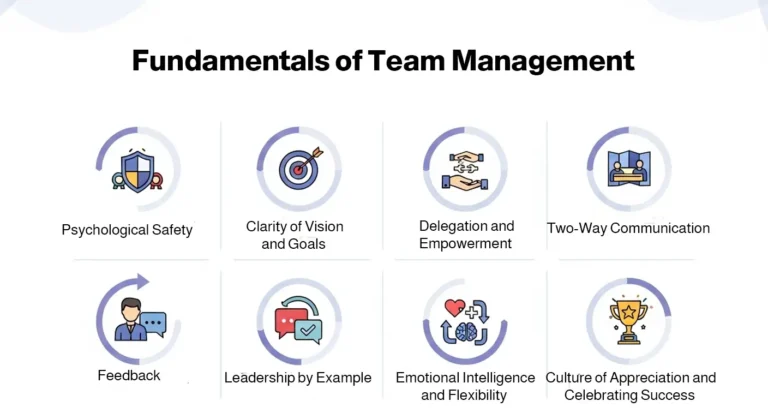
Building an effective team requires a deep understanding of the principles that drive its success. In this context, clarity of roles and responsibilities, mutual trust and respect, and fostering a unified team spirit are essential.
1. Clarity of Roles and Responsibilities
A team’s success begins with clearly defined roles and responsibilities. This clarity minimizes task overlap and ensures that every member knows exactly what is expected of them.
2. Documenting Tasks and Authority
Tasks and areas of authority should be clearly and thoroughly documented. This documentation helps reduce confusion and ensures all team members are aligned, promoting smooth workflow.
3. Building Trust and Mutual Respect
Trust and mutual respect among team members are the foundation of success. When members feel safe and respected, they are more willing to engage and contribute effectively.
4. Creating a Psychologically Safe Environment
A psychologically safe environment encourages team members to share their opinions and ideas without fear of criticism or rejection, fostering creativity and initiative within the team.
5. Fostering a Unified Team Spirit
Promoting a sense of “one team” involves organizing activities and events that bring members together and encourage collaboration, strengthening bonds and motivating them to work collectively.
6. Effective Team-Building Activities
Effective team-building activities include workshops and recreational events that enhance communication among members and build strong relationships, supporting overall team performance.
Effective Communication Skills with Team Members
Effective communication is the backbone of any successful team. Without it, a team can struggle to achieve its goals. In this section, we’ll explore the key skills for communicating effectively with team members and how to enhance them.
1. Active Listening and Feedback
Active listening is a core skill in effective communication. It goes beyond simply hearing what others say; it involves deep understanding, interpretation, and constructive engagement with the messages being shared.
Techniques for Deep Listening:
-
Give the speaker your full attention without interrupting.
-
Ask clarifying questions to ensure complete understanding.
-
Paraphrase what you’ve heard to confirm accuracy and understanding.
2. Clear and Transparent Communication
Clear communication reduces misunderstandings and builds trust among team members. Messages should be direct, specific, and unambiguous, whether delivered verbally or in writing.
3. Navigating Cultural Differences
In multicultural teams, it’s important to recognize and respect differences in communication styles. Team members should understand these variations and adapt accordingly to ensure smooth and effective collaboration.
4. Efficient Meeting Management
Effective meetings are a crucial part of team communication. By organizing meetings systematically and clearly, teams can achieve better outcomes and save time.
Techniques for Effective Remote Meetings:
-
Use the appropriate digital communication tools.
-
Set a clear agenda before the meeting.
-
Follow up on outcomes and action items after the meeting to ensure decisions are implemented.
Setting Goals and Managing Expectations in Teams
Clearly defining goals is the first step toward any team’s success. Without well-defined objectives, a team may struggle to focus its efforts effectively and achieve the desired results.
1. Crafting SMART Goals
SMART goals are characterized by the following attributes:
-
Specific: Clear and precise.
-
Measurable: Progress and achievement can be tracked.
-
Achievable: Realistic and attainable.
-
Relevant: Aligned with the team’s or organization’s strategy.
-
Time-bound: Set within a clear timeframe for completion.
Adopting this approach ensures that team goals are clear, actionable, and motivating for all members.
2. Practical Examples of Team Goals
Instead of setting a vague goal like “increase sales,” it can be turned into a clear SMART goal such as:
“Increase sales by 15% in the next quarter.”
This provides the team with a concrete direction and makes it easier to track progress and achieve results.
3. Aligning Team Goals with Organizational Strategy
Team goals should be aligned with the broader objectives of the organization. This ensures that the team’s efforts directly contribute to the overall strategy and maximize the team’s impact on final outcomes.
4. Monitoring Progress and Adjusting Course
Regularly tracking the team’s progress is crucial to staying on target. Tools that can help include:
-
Dashboards: Provide a clear view of team progress.
-
Key Performance Indicators (KPIs): Measure performance against established benchmarks.
By leveraging these tools, teams can manage expectations effectively, identify strengths and weaknesses, and adjust strategies as needed to ensure success.
Effective Task Delegation: The Key to Unlocking Your Team’s Potential
Effective task delegation is one of the most powerful strategies for successful team management. It allows team members to showcase their strengths and significantly improves overall team performance.
1. When and How to Delegate Tasks
Before delegating any task, assess your team members’ skills and capabilities to determine which tasks they can handle effectively.
Skill Assessment Includes:
-
Evaluating technical abilities and practical experience.
-
Identifying each member’s strengths and weaknesses.
-
Considering soft skills such as communication, teamwork, and problem-solving.
When delegating, it’s essential to be clear about expected outcomes and the resources available for each task.
2. Avoiding Common Delegation Mistakes
Common pitfalls in delegation include:
-
Failing to provide sufficient guidance to team members.
-
Exercising excessive control, which can stifle initiative and creativity.
3. Balancing Delegation and Oversight
The key to effective delegation is mutual trust. You can delegate tasks while maintaining the necessary oversight to ensure results are achieved, without restricting the team’s autonomy.
4. Building Independence and Accountability
To foster team independence, empower members to make appropriate decisions within their task scope. This includes:
-
Providing the information and resources needed for informed decision-making.
-
Encouraging participation in the decision-making process.
-
Supporting well-considered decisions based on clear facts.
Enhancing Team Commitment: Understanding Motivators and Building Team Spirit
Enhancing commitment within a team starts with a deep understanding of what drives each individual. This insight not only enables effective motivation but also strengthens team cohesion and boosts overall productivity.
-
Understanding the Different Motivators of Team Members
Each team member is motivated by different factors. Some may be driven by financial rewards, while others value recognition or opportunities for professional growth. Identifying these differences allows leaders to tailor their motivational efforts more effectively. -
Motivation Theories and Their Practical Applications
Motivation theories such as:
-
Maslow’s Hierarchy of Needs
-
McClelland’s Theory of Motivation
provide a framework for understanding what drives individuals. Applying these theories in practice can help design customized motivation strategies for each team member.
-
Strategies for Financial and Non-Financial Motivation
Motivation goes beyond financial incentives and also includes:
-
Recognition and praise for achievements.
-
Opportunities for professional development and career advancement.
-
Rewards and Recognition Programs
Reward programs can include:
-
Financial bonuses and promotions.
-
Public acknowledgment of individual and team accomplishments.
-
Symbolic awards that reflect appreciation and encouragement.
-
Acknowledging Achievements and Fostering a Culture of Celebrating Success
Recognizing achievements, no matter how small, strengthens team spirit and increases individual commitment. Creating a culture that regularly celebrates successes boosts morale and motivates everyone to perform at their best.
Conflict Management and Problem-Solving Within the Team
Effectively managing conflicts fosters a positive work environment and boosts team productivity. When disagreements arise, leaders must address them constructively, turning challenges into opportunities for growth.
Diagnosing the Causes and Types of Conflicts
Understanding the root causes of conflicts within a team is the first step toward successful resolution. Conflicts may stem from differing perspectives or competition over resources.
Early Signs of Conflict
Recognizing early indicators of conflict—such as changes in individual behavior or decreased communication—is crucial for timely intervention.
Conflict Resolution Strategies
Effective conflict resolution strategies include mediation and skilled negotiation. Leaders should promote open dialogue and active listening to facilitate understanding.
Mediation and Effective Negotiation
Successful mediation requires strong communication skills and the ability to listen attentively to all parties involved.
Turning Conflicts Into Opportunities for Growth
Conflicts can be transformed into opportunities for development by learning from challenging situations. This approach demands a positive mindset and a constructive, solution-oriented perspective.
Team Performance Evaluation and Development
Team Performance Evaluation and Development
Evaluating team performance is an essential part of any successful organization’s strategy. It helps identify strengths and weaknesses, highlights areas for improvement, and supports the development of team skills to enhance overall performance.
-
Setting Performance Standards
Performance evaluation begins with establishing clear standards aligned with organizational goals. These standards should be:
-
Clear and specific to avoid confusion.
-
Measurable to track progress effectively.
-
Quantitative and Qualitative Performance Indicators
Performance indicators include:
-
Quantitative indicators: such as numbers, sales figures, and productivity rates.
-
Qualitative indicators: such as customer satisfaction, work quality, and adherence to deadlines.
-
Providing Constructive Feedback
Constructive feedback is a key tool for performance improvement:
-
It should be specific and focused on behavior or results, not the individual personally.
-
A balanced feedback model that combines positive reinforcement with guidance on areas for improvement is highly effective.
-
Individual and Team Development Plans
Developing team members requires:
-
Individual plans: tailored to each member’s needs, helping them enhance their skills.
-
Team plans: designed to foster collaboration, strengthen teamwork, and support shared goals.
-
Identifying Training and Professional Development Opportunities
Leaders should:
-
Identify suitable training opportunities for each member based on their needs.
-
Encourage continuous learning to promote professional growth and improve overall team performance.
Building a Culture of Continuous Learning and Innovation
In today’s fast-changing business environment, fostering a culture of continuous learning and innovation is essential for achieving excellence. This requires leaders to create an environment that encourages creativity and learning from mistakes.
Encouraging Creative Thinking and Initiative
Promoting creative thinking begins with establishing a work environment that values initiative and innovation. This can be achieved by:
-
Encouraging brainstorming sessions and the generation of new ideas.
-
Supporting unconventional ideas and providing the resources needed to turn them into reality.
Brainstorming Sessions and Idea Generation
Brainstorming is a powerful tool for generating new ideas and innovative solutions to problems. It’s important to create an encouraging and open environment during these sessions.
Learning from Mistakes and Experiences
Learning from mistakes is a fundamental aspect of a continuous learning culture. This involves:
-
Analyzing errors and turning them into actionable lessons.
-
Implementing continuous improvement methodologies to enhance processes over time.
Applying Continuous Improvement Methodologies
Continuous improvement practices help streamline processes, reduce errors, and steadily enhance performance.
Keeping Up with Change and Adapting
Staying agile and adapting to change is crucial for maintaining team relevance and competitiveness. This includes:
-
Building team resilience to face challenges effectively.
-
Leveraging technology and innovation to enhance employee performance.
Building Team Resilience in Facing Challenges
A resilient team can quickly adapt to change and capitalize on new opportunities, ensuring sustained growth and success.
Situational Leadership
Every task may require a different leadership style, depending on its clarity, importance, and impact on team or organizational outcomes. Your role as a leader is most significant during challenging or complex tasks and less intensive for routine or straightforward tasks.
Leadership Styles and Their Impact on Team Performance
Leadership styles play a critical role in determining a team’s performance and overall success. A leader can choose from different styles to achieve the best outcomes.
Transformational vs. Transactional Leadership
Transformational leadership focuses on motivating team members to achieve shared goals through a common vision and inspiration. In contrast, transactional leadership emphasizes rewards and penalties to ensure compliance.
When to Use Each Leadership Style
Transformational leadership is most effective in dynamic work environments that require innovation and creativity. Transactional leadership is better suited for environments where adherence to rules and regulations is essential.
Adapting Leadership Style to Team Needs
Leaders should tailor their approach based on the team’s needs and the specific work context.
Situational and Flexible Leadership
Situational leadership requires leaders to be adaptable and capable of adjusting their style to fit different circumstances.
Developing Personal Leadership Skills
Leaders should continuously work on enhancing their leadership abilities, including:
-
Emotional Intelligence: Essential for understanding team needs and managing relationships effectively.
-
Communication Skills: Clear and effective communication strengthens collaboration.
-
Decision-Making Abilities: Enables confident and timely choices that guide the team.
-
Building Trust: Establishing trust with team members fosters loyalty, engagement, and performance.
Effective team management plays a pivotal role in achieving desired outcomes within any organization. By understanding team dynamics, setting clear goals, and delegating tasks efficiently, teams can deliver tangible results.
Additionally, effective communication, motivating team members, and constructively managing conflicts all contribute to enhancing team performance and achieving shared objectives. Embracing a culture of continuous learning and innovation, along with developing strong leadership skills, is also critical for ensuring sustained success.
By applying the principles and strategies outlined in this article, leaders and stakeholders can strengthen their teams’ capabilities and achieve the results they aim for. Effective team management is not just a goal—it is an ongoing process that requires commitment and continuous effort.
- February 2, 2026
- PeakTime Team
- 2:46 pm
أحدث المقالات
Recent Posts
- Employee KPIs: A Strategic Tool to Boost Performance and Foster a Culture of Excellence
- Job Performance Evaluation: Its Role and Importance in Organizational and Employee Development

- Performance Management: Tools and Strategies for a Successful Manager
- Foundations of Successful Team Management: How to Achieve Results with Any Team
- Common Task Management Mistakes — and How to Avoid Them Using Modern Systems