Traditional methods of managing time and tasks are no longer sufficient to ensure high levels of productivity or effective accountability—especially within geographically distributed teams. With the growing adoption of remote and hybrid work models, and the accelerating pace of digital transformation, time-tracking technologies with screenshot capabilities have emerged as smart tools that allow organizations to monitor workflows accurately and transparently—without compromising company culture or employee autonomy.
These tools make it possible to measure the actual time spent on different tasks, fostering self-discipline and reinforcing a results-oriented performance culture. They also provide valuable support for decision-makers by improving resource planning, minimizing wasted time, and reducing unnecessary downtime.
In flexible work environments, the importance of such tools continues to grow, serving as a bridge to build mutual trust between employees and management while overcoming communication and supervision challenges faced by remote teams. Integrating screenshot-based time tracking represents a strategic step toward maximizing productivity, enhancing operational efficiency, and achieving a sustainable balance between flexibility and discipline in the digital era.
The Concept of Time Tracking with Screenshots in Digital Work Environments
The Importance of Time Tracking with Screenshots in Modern Work Environments
Time tracking with screenshots is one of the most impactful digital tools for both employees and organizations—particularly in today’s flexible workplaces where teams are often distributed across different locations.
First, this system helps employees improve their self-management by increasing awareness of how their working hours are spent on various tasks. This heightened awareness fosters discipline, focus, and efficiency while reducing procrastination and time waste. Screenshot records also provide an objective account of completed tasks, giving employees tangible proof of their efforts and promoting fairness and recognition from management.
Second, the system reinforces transparency and accountability between employees and management. Screenshots offer an accurate view of workflow progress without requiring constant supervision or direct oversight, which builds mutual trust and alleviates concerns about excessive monitoring. This feature is especially valuable in remote and hybrid work environments, where objective tracking minimizes misunderstandings and strengthens collaboration and mutual respect.
Third, the system provides precise, analyzable data on both individual and team performance, enabling management to assess efficiency and identify areas for improvement. It also helps employees refine their skills and prioritize tasks more effectively. As a result, time tracking with screenshots enhances productivity, elevates work quality, and fosters a professional work culture capable of keeping pace with the demands and challenges of digital transformation.
Benefits of Time Tracking with Screenshots for Organizations and Employees
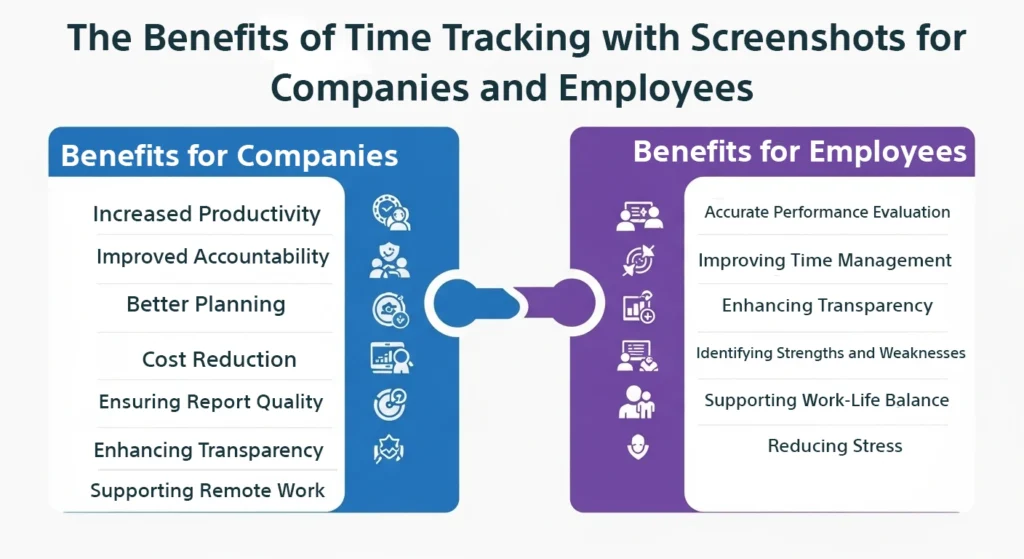
- Boosted Productivity: Screenshots provide a clear view of work behaviors, helping identify sources of distraction or wasted time. This insight allows for better time management and increased overall productivity.
- Enhanced Accountability: Visual evidence from screenshots confirms employees’ adherence to work hours and tasks, strengthening their responsibility toward performance.
- Improved Planning: Visual data aids in optimizing task and resource allocation and in identifying training needs based on actual performance analysis.
- Cost Reduction: By monitoring wasted time and minimizing unproductive activities, companies can lower operational costs and increase profitability.
- Accurate Reporting: Screenshots create a reliable record of work hours, improving billing, performance evaluation, and project management processes.
- Transparency: They build management’s trust in work reports and foster a culture of openness within the organization.
- Support for Remote Work: Screenshots make it easier to monitor remote teams’ performance without the need for constant supervision or micromanagement.
Benefits for Employees:
Accurate Performance Evaluation: Time tracking with screenshots provides precise data that truly reflects their efforts, ensuring fair assessment of achievements.
Better Time Management: By analyzing how time is spent, employees can organize their work hours more effectively and enhance focus.
Increased Transparency: Access to their own screenshots builds trust and reduces concerns about being constantly monitored.
Identifying Strengths and Weaknesses: Employees gain insight into areas where they excel or need skill development.
Support for Work-Life Balance: Accurate time monitoring helps employees balance work tasks with personal time more effectively.
Reduced Stress: A clear and transparent system alleviates performance anxiety and fosters a healthier work environment.
Ethical and Regulatory Frameworks for Screenshot-Based Time Tracking
Tracking systems should operate under clear and transparent supervision, informing employees about the purpose of use, data collection methods, and how the data will be handled. This clarity fosters mutual trust and reduces feelings of excessive monitoring or privacy intrusion.
It is essential to establish clear policies governing data collection, storage, and usage, limiting it strictly to professional activities and requiring employees’ explicit prior consent. Monitoring outside work hours or in personal spaces should be strictly avoided, in compliance with local and international data protection and privacy laws.
Time-tracking technologies should not serve as a pressure tool, but rather as a supportive mechanism to enhance team productivity and performance. Achieving this balance requires a work environment that encourages achievement while providing psychological safety, underpinned by fair policies and open communication between management and employees, reinforcing shared organizational values.
These practices must adhere to relevant legal and ethical standards, including safeguarding personal information, ensuring confidentiality of professional communications, and complying with data protection regulations such as national laws or regional standards like the GDPR.
Challenges and Solutions in Implementing Screenshot-Based Time Tracking Systems
Protecting privacy is one of the foremost challenges, as some employees may worry about potential data misuse or excessive monitoring. To address this, organizations should establish clear and transparent policies outlining the purpose of tracking, how data is collected, and the scope of its use, while strictly adhering to information security and confidentiality standards. Clear communication about the system’s objectives helps build trust and alleviates related concerns.
Tracking systems may initially be perceived as surveillance tools rather than enabling mechanisms, leading to internal resistance. The solution lies in fostering awareness and acceptance by clearly explaining the benefits of tracking for productivity and time management, emphasizing that it supports professional performance rather than restricting it. Involving employees in the planning and implementation stages also turns the experience into a positive development opportunity.
Effective and sustainable implementation requires regular updates to policies and procedures to align with technological advances and legal regulations. Policies should include mechanisms for continuous review and allow employees to contribute to system evaluation and suggest improvements. Choosing tracking tools with high flexibility and advanced privacy features—such as blurring or deleting sensitive screenshots—helps balance accountability with privacy protection.
Effective Steps for Implementing Employee Screen Monitoring
- Disclosure and Transparency: Inform employees in advance about the monitoring system and its objectives.
- Balancing Privacy and Monitoring: Capture screenshots only during work hours and avoid recording personal information.
- Using Advanced Technologies: Employ secure, automated screenshot software with encryption features.
- Objective Data Analysis: Use screenshots to enhance performance, not for arbitrary punishment.
- Continuous Policy Updates: Regularly review policies to keep pace with work and technological developments.
In conclusion, automatic screenshot monitoring is a powerful tool that promotes transparency and accountability within digital workplaces. When integrated with modern employee management systems like PeakTime, this technology provides precise documentation of digital activity, helping improve performance and ensure adherence to company policies. Applied thoughtfully and with respect for employee privacy, these tools become an essential part of building a work culture rooted in trust and efficiency—benefiting everyone within the organization.
أحدث المقالات
Recent Posts
- Fundamentals of Performance Management: Your Path to Administrative Excellence
- Performance Improvement Plan (PIP): Effective Strategies for Managing Underperformance in Organizations

- Employee Performance Measurement Using Key Performance Indicators (KPIs)

- Employee KPIs: A Strategic Tool to Boost Performance and Foster a Culture of Excellence

- Job Performance Evaluation: Its Role and Importance in Organizational and Employee Development