
How Can a Task and Time Management Tool Transform the Way Your Team Works?
In today’s fast-paced work environment, with multitasking and remote teams becoming the norm, traditional time and HR management methods are no longer enough to ensure efficiency and sustainability. This is where task and time management software comes in—as strategic tools that truly transform team workflows and help organizations shift from operational management to data-driven strategic management.
The Importance of Task and Time Management in Today’s Workplace
Today, team productivity depends on the ability to organize work, set clear priorities, and make the most of time. As projects become more complex, teams face challenges such as:
-
Distractions and lack of focus
-
Difficulty prioritizing tasks
-
Work pressure and missed deadlines
-
Lack of clear insight into time and resource usage
Poor time management not only slows down task completion but also negatively impacts work quality, employee satisfaction, and organizational stability.
What Are Task and Time Management Software?
- Plan and clearly assign tasks.
- Track progress in real time.
- Record and analyze the time spent on each task.
- Generate reports that support evaluation and decision-making.
Key Benefits of Using Task and Time Management Software
1- Increased Productivity and Efficiency
By clarifying responsibilities and setting priorities, wasted time is minimized, and focus is directed toward high-value tasks.
2- Better Planning and Resource Allocation
Analyzing task and time data helps management:
- Redistribute effort fairly
- Improve timeline estimates
- Identify and address inefficiencies.
3- Enhanced Communication and Collaboration
These tools offer a centralized platform for tracking work, minimizing misunderstandings, and enhancing coordination, particularly for geographically dispersed teams.
4- Reduced Stress and Improved Work Quality
When work is organized and expectations are clear, stress decreases, while employee satisfaction and output quality increase.
The Role of HR Software in Task and Time Tracking
Human resource management is no longer limited to attendance and payroll; it has become a strategic partner in enhancing organizational performance. Integrating HR software with task and time management systems enables:
-
Accurate tracking of working hours and employee attendance
-
Linking performance to actual task completion
-
Objective evaluations based on real data
-
Reduced errors in payroll and incentives
This integration also promotes transparency, accountability, and trust between management and employees.
The Impact of Time Tracking on Work Culture and Employee Behavior
When implemented professionally and balanced, time tracking can shift from a monitoring tool to a development tool by:
-
Enhancing self-discipline and time management
-
Increasing awareness of the value of time
-
Promoting a results-oriented culture rather than just busyness
Maintaining a balance between oversight and trust remains essential for the success of these systems.
Digital Transformation in Human Resource Management
Modern organizations rely on digital solutions to turn daily operational data into strategic insights. Advanced work management platforms enable:
-
Efficient management of remote teams
-
Accurate tracking of time and tasks
-
Real-time analytical reporting
-
Support for compliance with regulations and policies
This transformation allows HR departments to shift from an administrative role to an analytical and consultative one that supports decision-making.
How Do These Tools Transform the Way Teams Work?
When a comprehensive task and time management system is implemented, organizations experience:
-
Greater clarity in role assignments
-
Higher adherence to deadlines
-
Tangible productivity improvements, often up to 25% or more
-
Data-driven management decisions instead of relying on estimates
Choosing the Right Software for Your Team
To ensure success, consider the following:
-
Team size and nature of work
-
Ease of use
-
Quality of reporting and analytics
-
Integration with other systems
-
Flexibility to support both in‑office and remote work
Implementation Challenges and How to Overcome Them
The main challenges include:
-
Resistance to change
-
Privacy concerns
-
Difficulties integrating with existing systems
These can be overcome by:
-
Continuous training
-
Transparency in data usage
-
Involving employees in the transformation process
From Theory to Practice: How “PeakTime” Supports Achieving HR Management Goals
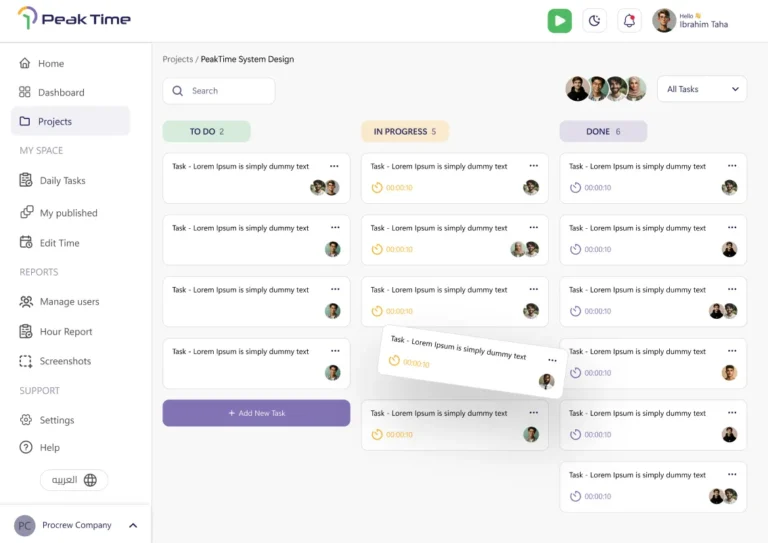
After exploring the strategic importance of task and time management, the key question arises: how do you choose the tool that turns these concepts into tangible results? This is where PeakTime comes in—a platform specifically designed to be the digital partner for modern HR departments. It doesn’t just track hours; it completely reshapes team performance by:
How Does PeakTime Support Human Resource Management?
-
Simplifying Team Management in Complex, Distributed Environments
With the rise of remote work and multiple time zones, manually tracking individual performance becomes challenging. -
Enhancing Transparency and Accountability
Fosters a results-driven culture and self-discipline by measuring performance transparently. -
Reducing Costs and Boosting Efficiency
Time-tracking tools and precise analytics help lower operational costs and improve resource utilization.
Why Peak Time Is the Best Choice to Boost Your Team’s Productivity?
In today’s dynamic business landscape, time tracking is no longer just a tool for monitoring attendance; it has evolved into a strategic asset for boosting productivity, streamlining workflows, and enhancing efficiency at all levels.
Whether you manage a small business or a large enterprise, Precise time tracking and management with professional tools like PeakTime can significantly elevate your team’s performance. Here are the key benefits:
1- Optimized Time and Resource Management
By tracking time spent on tasks and projects, businesses can identify inefficiencies. This enables smarter, more effective resource allocation.
2- Accurate Performance Analysis
Time tracking provides a realistic assessment of individual employee performance, facilitating:
- Recognition of individual achievements.
- Identify employees needing additional support or training.
- Data-driven improvements to work strategies.
3- Reduced Waste and Increased Productivity
Documenting time spent on core tasks minimizes non-essential activities and shifts the team’s focus to high-priority objectives, potentially increasing productivity by up to 25%.
4- Improved Deadline Adherence
Time tracking enables accurate estimation of task completion times, enhancing project scheduling, reducing unexpected delays, and boosting client satisfaction.
5- Precise Client Billing
For agencies and freelancers, time tracking ensures invoices reflect actual hours worked, fostering transparency and guaranteeing fair compensation for every hour invested.
6- Data-Driven Decision Making
Accurate time data empowers management to make informed strategic decisions regarding hiring, task allocation, and process optimization.
7- Fostering a Culture of Accountability and Self-Discipline
When employees know their time is tracked professionally and transparently, it motivates them to stay focused, minimizes distractions, and reduces unwarranted delays.
How PeakTime Enhances Team Performance
1- Building Data-Driven Management Decisions
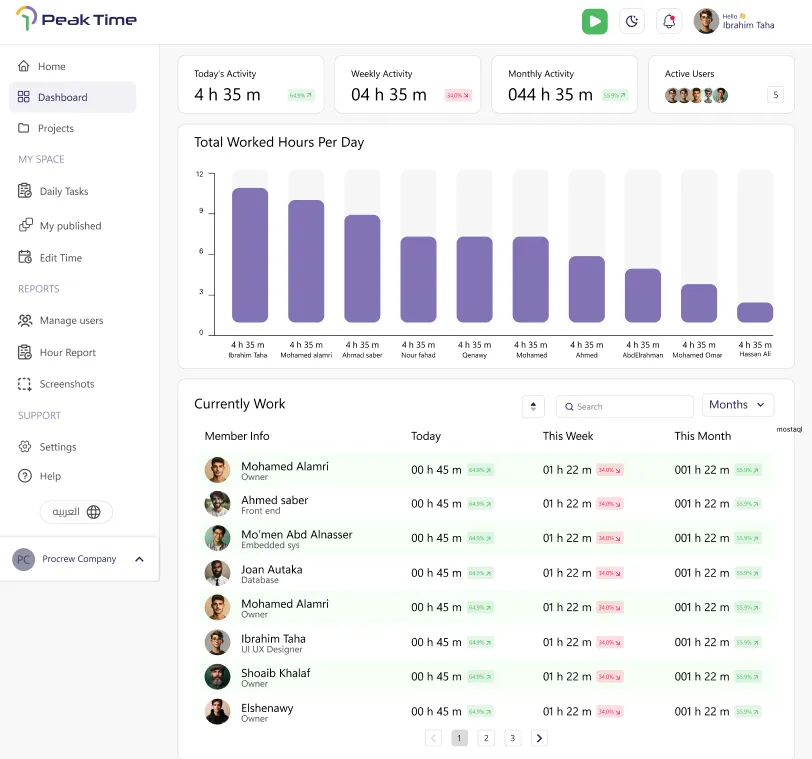
Through real-time analytics, managers can swiftly and effectively adjust policies and procedures to optimize team performance.
2- Encouraging Commitment and Self-Discipline
With the understanding that job performance is measured accurately, employees’ individual commitment increases.
3- Elevating Teamwork Quality
Clear task allocation and real-time status updates reduce conflicts and accelerate project completion, fostering seamless collaboration.
Start Your Digital Transformation with PeakTime
Organize your team’s tasks, track time accurately, and boost their productivity by up to 25% or more.
Request a Free TrialComparison: PeakTime VS Traditional Tools
Feature | PeakTime | Traditional tools |
Time Tracking Accuracy | Highly accurate, automated | Moderately accurate, often manual |
Ease of Use | Intuitive, flexible interface | Often complex or outdated |
Performance & Productivity Monitoring | Real-time, in-depth analytics | Basic or limited |
Task & Project Management | Fully integrated, priority-based | Requires external tools |
Integration with Other Tools | Seamless with popular platforms | Limited or indirect |
Reporting & Analytics Quality | Comprehensive, real-time insights | Delayed or basic |
Who Can Benefit from PeakTime?
PeakTime is ideal for:
- Startups that need an efficient and cost-effective time-tracking solution.
- Large enterprises require advanced reporting and broad-scale analytics.
- Remote or distributed teams that need to document work and ensure transparency.
- Creative and tech agencies that rely on hourly billing or performance-based productivity.
Practical Tips for Using PeakTime Efficiently
- Train your teams on the system tools from day one.
- Customize settings according to each team’s or department’s needs.
- Analyze periodic reports to optimize workflow.
- Integrate PeakTime with your existing digital tools.
- Set clear KPIs (Key Performance Indicators) and review them regularly.
In the era of digital transformation and increasing reliance on automated solutions, relying solely on individual efforts or traditional methods for team management is no longer sufficient.
Instead, a smart platform like PeakTime is required—one that combines analytics, insight, and ease of use within a unified framework.
PeakTime is not just an employee management platform; it is a strategic tool that boosts team productivity, improves decision-making, and provides organizations with a competitive edge in a market that demands the highest levels of efficiency and organization.
Frequently Asked Questions
أحدث المقالات
Recent Posts
- Fundamentals of Performance Management: Your Path to Administrative Excellence

- Performance Improvement Plan (PIP): Effective Strategies for Managing Underperformance in Organizations

- Employee Performance Measurement Using Key Performance Indicators (KPIs)

- Employee KPIs: A Strategic Tool to Boost Performance and Foster a Culture of Excellence

- Job Performance Evaluation: Its Role and Importance in Organizational and Employee Development
