
Performance Management: Tools and Strategies for an Effective Manager
As a manager performance management goes far beyond simply monitoring employees. It is a core tool for understanding how your team works and for driving the best possible results. From evaluating overall team productivity to tracking tasks and individual achievements, using the right tools and strategies allows you to identify strengths, address gaps, and continuously enhance collaboration and efficiency. This article explores practical approaches that help you manage performance intelligently and achieve sustainable success for your team.
The Importance of Regular Performance Reviews and Feedback Sessions
In addition to setting goals and establishing Key Performance Indicators (KPIs), regular performance reviews and feedback sessions are the driving force behind team growth. According to a report by the global firm Gallup, employees who receive daily or weekly feedback are 3.2 times more likely to be engaged at work than those who do not.
These numbers are more than statistics—they highlight that continuous communication gives you, as a manager, a golden opportunity to:
Assess performance in real time: Instead of waiting for an annual review that may come too late.
Receive constructive feedback: Gain insight into team challenges before they escalate.
Reduce employee turnover: Recognition and consistent follow-up boost loyalty among your top talent.
How to Conduct Effective Performance Reviews
Schedule Regular Reviews
Set a consistent timeline for performance reviews and stick to it. This ensures timely and uniform evaluations.Prepare in Advance
Gather performance data, examples of team achievements, and past feedback to demonstrate your commitment and professionalism.Encourage Two-Way Communication
Create an open environment that supports feedback, and encourage team members and colleagues to share honest, constructive input.Focus on Strengths and Improvement Areas
Acknowledge achievements and strengths, while remaining open to suggestions to set actionable goals and ongoing development plans.Leverage Performance Management Tools
Digital tools streamline the evaluation process, save time and effort, and enhance the accuracy and objectivity of assessments.
Performance Management Tools for Managers
A. Performance Management Systems
Provide a centralized platform for setting goals, tracking tasks, and analyzing performance, with comprehensive reporting to support informed decision-making.
B. Feedback Tools
Collect input from employees and peers, offering a complete view of performance and time spent on tasks, helping identify areas for improvement.
C. Data Analytics Tools
Analyze performance data, identify trends, and provide visualizations and charts to support evidence-based decision-making.
D. Time and Task Tracking Tools
Allow you to monitor actual time spent on each task, optimize resource allocation, and ensure goals are achieved on schedule.
Strategies for Using Performance Management Tools Effectively
Integrate Tools into Daily Workflow
Incorporate performance management tools into everyday tasks to capture accurate and continuous data.Regularly Review Analytics
Examine performance data periodically to identify strengths and gaps, and take corrective action as needed.Train Employees on Tool Usage
Educate team members on using the tools effectively to maximize benefits and ensure full engagement.Combine Feedback with Digital Analysis
Use feedback alongside analytics to develop a comprehensive team development plan.
The Role of Employee Engagement in Enhancing Performance
Employee engagement reflects commitment and dedication, directly impacting productivity and team satisfaction.
Ways to Measure Employee Engagement:
Employee Surveys: Assess job satisfaction, work-life balance, and overall happiness.
Regular Feedback and Communication: Foster an open, supportive culture and address issues promptly.
Recognition and Rewards: Boost motivation and reinforce a sense of value for top performance.
Opportunities for Growth and Development: Offer training programs, mentoring, and clear paths for career advancement.
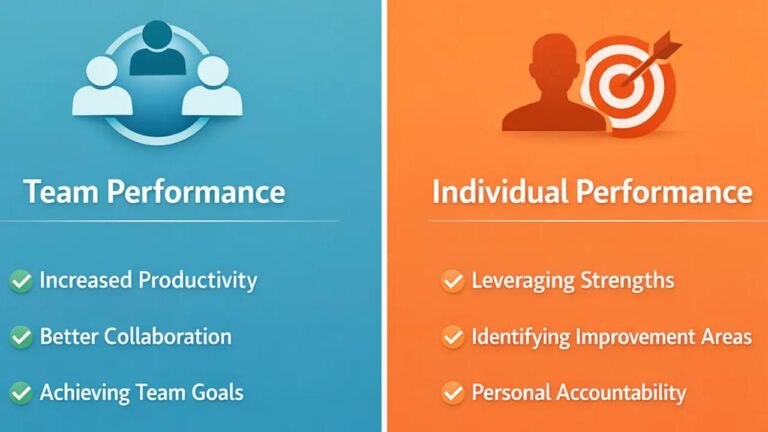
Team Performance vs. Individual Performance Evaluation
Performance evaluation in human resource management is a key tool for developing employee capabilities and achieving organizational goals. It enables the assessment of both individual and team effectiveness.
Team Performance: Measures overall efficiency and productivity, highlighting the success of collaboration and communication.
Individual Performance: Identifies each member’s strengths and areas for improvement, helping to uncover synergies and gaps.
Evaluation Steps:
Assess the team using key metrics such as productivity, efficiency, and goal achievement.
Evaluate each individual through regular reviews of accomplishments and peer feedback.
Analyze data to identify synergies and gaps between individuals and the team.
Provide targeted support and development to ensure continuous improvement and growth.
Top Performance Management Tools for Managers (Practical Application with Peak Time)
First: Centralized Performance Management Systems
Instead of having data scattered across emails and paper notes, tools like PeakTime provide a single dashboard that consolidates team objectives (OKRs) and links them to daily tasks. This gives you a complete overview of project progress with just one click, making performance tracking faster and easier without searching through multiple sources.
Second: Time and Task Tracking Tools
Many managers struggle to pinpoint where their team’s time is being lost, often due to digital distractions. PeakTime’s real-time time-tracking feature measures the efficiency of each task without monitoring employees personally. For example, if a simple task takes five hours, the app helps you identify workflow gaps and address them immediately before they cause project delays or increased pressure on the team.
Third: Data Analytics Tools
Instead of relying on intuition for management or evaluation, PeakTime’s analytics provide precise reports on resource allocation and performance. You can see who is overloaded and who has capacity for additional tasks, ensuring fair, data-driven workload distribution. This enables informed decisions that continuously enhance team performance.
In many organizations, managers struggle to accurately track team performance due to multiple responsibilities and a lack of effective monitoring tools. This makes evaluating individual and team productivity a significant challenge, impacting decision-making and goal achievement.
The solution lies in using digital performance management tools that allow you to track tasks and the time spent on them, analyze data clearly, and review both individual and team accomplishments. These tools help managers identify strengths and gaps, optimize task distribution, and continuously enhance team performance.
Try Peak Time today to simplify performance management and monitor your team’s productivity in a practical and precise way.
- February 2, 2026
- PeakTime Team
- 4:42 pm
أحدث المقالات
Recent Posts
- Fundamentals of Performance Management: Your Path to Administrative Excellence

- Performance Improvement Plan (PIP): Effective Strategies for Managing Underperformance in Organizations

- Employee Performance Measurement Using Key Performance Indicators (KPIs)

- Employee KPIs: A Strategic Tool to Boost Performance and Foster a Culture of Excellence

- Job Performance Evaluation: Its Role and Importance in Organizational and Employee Development
