
How to Choose and Implement the Right Time-Tracking Systems for Your Company
What gets measured gets managed.” Studies show that companies that fail to adopt accurate time-tracking systems can lose up to 20% of their profits due to human error or poor time management. This clearly highlights the critical role time-tracking systems play in effective workforce management.
But what exactly are modern time-tracking systems? They are far more than simple clock-in and clock-out tools. Today’s solutions are comprehensive platforms designed to analyze employee productivity and accurately measure individual performance. In this article, we move beyond traditional “attendance monitoring” to focus on true “productivity management,” offering a complete guide to choosing the right system for your company and implementing it smoothly—without triggering employee resistance.
Why Does Your Company Need a Time-Tracking System?
Your company needs a time-tracking system to ensure accurate recording of actual working hours and to minimize manual payroll errors, while benefiting from comprehensive features that help boost productivity and improve human resource management.
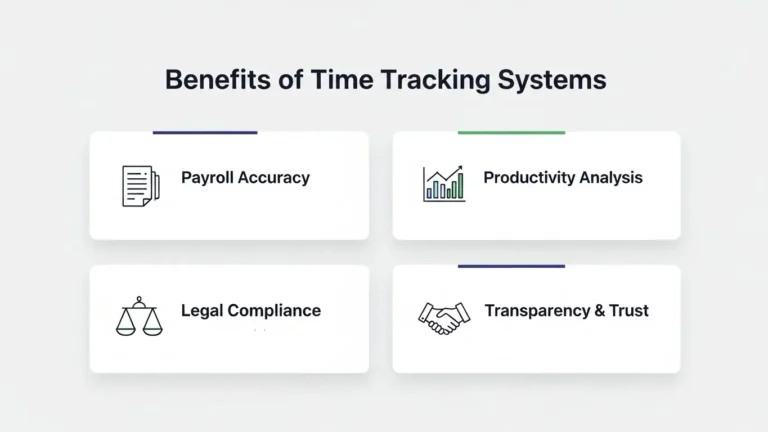
Benefits of Time-Tracking Systems:
-
Benefits of Time-Tracking Systems:
Accurate Payroll: Prevents overpayment or underpayment by up to 90%.
Productivity Analysis: Reveals how time is allocated across tasks and identifies daily waste and distractions.
Saudi Legal Compliance: Integrates with the Telework platform, accurately recording attendance and leave.
Prevents Tardiness and Absenteeism: Eliminates practices like “buddy punching” and reduces unexcused absences.
Transparency and Trust: Fosters a positive work culture without compromising employee privacy.
HR Time Savings: Automates routine reports, allowing HR to focus on training and development.
Improved Resource Allocation: Highlights the optimal distribution of effort across tasks and projects.
Supports Hybrid Work: Ideal for remote teams, boosting efficiency by 20–30%.
Instant Reports: Provides daily and weekly insights for quick strategic decision-making.
Reduced Overall Costs: Limits time misuse and improves client billing accuracy.
Enhanced Job Satisfaction: Helps employees manage their personal time more effectively.تشمترح
Criteria for Choosing the Right Time-Tracking System
Choosing a time-tracking system isn’t about picking the “most popular” tool—it’s about finding the one that fits your company’s workflow. A system that’s too complex will face employee resistance, while one that’s too simple may not provide the insights needed for strategic decision-making.
Here are six key criteria that time management experts use when evaluating any time-tracking software:
1. Ease of Use and User Experience
Ease of use is critical for system adoption. If entering data takes too long, employees will see it as an extra burden.
-
Intuitive Interface: Can new employees start and stop the timer without extensive training?
-
Self-Correction: Does the system allow manual adjustments when a timer is accidentally missed (with manager approval)?
2. Integration Capabilities
A standalone system adds limited value. Your time-tracking software should “talk” to your other tools to avoid duplicate data entry.
-
Project Management Integration: Connect with tools like Asana or Jira to link time directly to tasks.
-
Open API: Allows custom integration with your internal systems if needed.
3. Data Quality and Reporting
Time tracking isn’t just about documentation—it’s about analysis and decision-making.
-
Profitability Reports: Compare employee hours to project value.
-
Real-Time Dashboards: See who is working on what at any moment.
-
Customizable Reports: Export data in PDF, CSV, or Excel formats and filter by employee, department, project, or client.
4. Ethical Monitoring Features
Monitoring should balance oversight with employee privacy.
-
Screenshots: Capture only during tracked work to assess performance, with options to blur sensitive data.
-
Task and Time Tracking: Monitor the actual time spent on tasks and projects to improve work distribution and efficiency.
5. Budget and Pricing Structure
Watch out for hidden costs before making a decision.
-
Per-User Pricing: Ideal for small to medium teams that plan to scale.
-
Flat Rate: Suitable for very large teams, though less common.
-
Free Version: Check for limits on project count or report retention.
6. Technical Support and Security
Employee and client data is non-negotiable.
-
Legal Compliance: Aligns with data protection laws like GDPR.
-
Encryption: Protects data during transfer and storage.
-
Responsive Support: Fast assistance via chat or email whenever issues arise.
Best Practices for Implementing a System in a Company
- Evaluation Phase: Analyze the needs of different departments (Finance, Human Resources, Operations).
- Research and Comparison: Create a shortlist of three software options and test them through free trials.
- Pilot Testing: Implement the system with a small team before rolling it out company-wide.
How to Overcome Employee Resistance
- Transparency: Explain why the system is being used (the aim is fairness and productivity, not surveillance).
- Employee Engagement: Involve the team in selecting the tool.
- Reward-Oriented Approach: Tie accurate time tracking to incentives or flexible work options.
- Privacy Assurance: Ensure that no screenshots or personal data are collected unnecessarily.
In today’s business world, tracking work hours is no longer just an administrative tool—it has become a cornerstone for managing productivity and making informed decisions. Choosing the right system and implementing it correctly can make a real difference in payroll accuracy, team efficiency, and project profitability, without negatively affecting workplace culture or employee privacy.
The key to success isn’t strict monitoring—it lies in transparency, ease of use, and turning data into actionable insights that benefit both management and employees. When a time-tracking system is implemented following best practices and with team involvement from the start, it becomes a tool for empowerment rather than pressure.
If your goal is to reduce waste, optimize effort allocation, and build a more organized and trustworthy work environment, investing in the right time-tracking system isn’t optional—it’s a strategic step toward sustainable growth and higher productivity.
Looking for an affordable employee time-tracking solution?
Start today with PeakTime — the smart resource planning software that combines time tracking, scheduling, and task management in a single, easy-to-use platform.
- December 15, 2025
- PeakTime Team
- 1:44 pm
أحدث المقالات
Recent Posts
- Fundamentals of Performance Management: Your Path to Administrative Excellence

- Performance Improvement Plan (PIP): Effective Strategies for Managing Underperformance in Organizations

- Employee Performance Measurement Using Key Performance Indicators (KPIs)

- Employee KPIs: A Strategic Tool to Boost Performance and Foster a Culture of Excellence

- Job Performance Evaluation: Its Role and Importance in Organizational and Employee Development
