Selecting the right task management system for remote teams is a strategic step in ensuring the success of any organization that relies on flexible or digital work models. A smart task management system goes beyond simply tracking progress and assigning responsibilities—it serves as a comprehensive framework that guarantees organization, transparency, and seamless team performance, regardless of where team members are located.
Such systems monitor remote employee performance and manage workflows through advanced digital tools that track tasks, measure productivity, and provide real-time analytical reports to support decision-making. Management can oversee adherence to deadlines, balance workloads, and evaluate execution efficiency based on accurate, continuously updated data.
Thanks to this intelligent digital infrastructure, achieving integrated team performance and fostering cohesion among individuals becomes possible, directly enhancing the quality of outcomes and the speed of delivery. Therefore, choosing the most suitable task management system is no longer merely a technical decision—it is a strategic choice that reflects an organization’s maturity in effectively and sustainably managing a remote work environment.
Task management is the process that ensures work is completed correctly and on time to achieve defined goals efficiently. It combines elements of planning, organizing, executing, and monitoring within a set timeframe and available resources, making it the backbone of any successful administrative process.
The process begins by precisely defining what needs to be accomplished, then assigning responsibilities to the right individuals based on their skills and areas of expertise. Priorities are set, and tasks are scheduled accordingly. Execution is then tracked step by step, with results evaluated to ensure objectives are met with the highest possible quality.
In modern work environments, especially those relying on distributed teams or remote work, task management has become an indispensable tool for coordinating efforts and continuously monitoring progress. Digital task management systems further enhance communication among team members, reduce time wastage, and increase transparency in workflow.
Consequently, task management is no longer merely a tool for organizing time—it is a comprehensive system that supports productivity and helps organizations balance speed with quality, making it an essential element for the success of any contemporary team.
Task management is not merely a sequence of consecutive steps; it is a journey that begins with an idea and culminates in tangible achievements. This journey requires careful planning, effective collaboration among team members, and the use of smart digital tools that transform effort into measurable outcomes. The following stages are essential to ensuring successful and well-organized task management:
1. Planning and Prioritization
Every great achievement starts with a clear plan.
Task management begins with precisely defining objectives and clarifying the purpose of each task, then categorizing them according to importance and urgency. Utilizing a priority matrix, such as the Eisenhower Matrix, is highly effective at this stage, as it helps direct efforts toward the tasks with the greatest impact.
Setting realistic timelines and clear deadlines is also crucial to ensure adherence and achieve high-quality results.
2. Task Assignment and Monitoring Time & Resources
The next stage is transforming the plan into organized, actionable work.
Tasks are assigned to team members based on their skills and expertise, optimizing the use of human resources. Time-tracking systems and resource monitoring tools help assess execution efficiency, while digital task management platforms provide interactive dashboards that display the real-time status of each task, enhancing transparency and precision in management.
3. Execution, Monitoring, and Performance Evaluation
Once execution begins, precise monitoring and performance evaluation become critical success factors.
Regular check-ins track progress, address challenges promptly, and maintain alignment through short, effective meetings. At the end of the cycle, a comprehensive performance review is conducted using key indicators such as deadline adherence, quality of output, and team collaboration. This stage fosters a culture of continuous improvement within the organization.
4. The Role of Digital Tools in Tracking Progress and Results
Modern digital tools are no longer optional—they are essential in today’s work environment.
Advanced task management systems provide interactive dashboards that display real-time work progress and generate detailed analytical reports highlighting individual and team performance.
These insights enable managers to make informed, timely decisions, optimize time and resource allocation, and increase operational efficiency. Additionally, these tools facilitate real-time collaboration among team members through instant updates and structured feedback sharing, reducing confusion and boosting productivity.
According to Aurik (2018) on the Global Economics Organization website, modern digital technologies have simplified decision-making processes for leaders and teams. High-precision analytical tools quickly collect, analyze, and deliver insights and forecasts. Many are now AI-enabled, allowing leadership to automate operational decisions while focusing only on evaluating results and making final judgments. These technologies have significantly reduced the time required for traditional decision-making stages, enabling leaders to concentrate on critical strategic areas.
With the rise of remote work culture and the adoption of hybrid models that combine office and home-based work, managing teams has become one of the most significant challenges for modern organizations. The need for a comprehensive task management system has never been greater, given the communication difficulties, progress tracking, and deadline adherence challenges that geographically distributed teams face.
A task management system is not merely an organizational tool—it is the digital framework that unifies team efforts and creates a single point of convergence for all daily operations. It provides a centralized dashboard for tracking tasks, sharing files, and updating statuses in real time, ensuring that everyone remains aligned toward achieving common goals, regardless of time zones or work locations.
These systems also enhance transparency among team members, reduce inefficiencies caused by poor coordination or task duplication, and empower leaders to make data-driven decisions based on accurate insights into individual and team performance.
In short, a comprehensive task management system acts as the organizational engine for hybrid teams. It combines digital flexibility with operational discipline, transforming geographic dispersion into harmonious, coordinated performance that achieves organizational goals efficiently and sustainably.
Distributed teams in remote work environments face a range of challenges that can hinder cohesion and productivity. One of the most significant obstacles is weak communication among team members, which can lead to feelings of isolation or disconnection from the group. Continuous performance monitoring also becomes more difficult without structured systems in place.
External factors, such as differences in time zones and internet connectivity issues, can further complicate collaboration, sometimes causing delays in task delivery or misunderstandings in responsibility allocation.
The absence of a centralized work management system exacerbates these issues, negatively impacting the quality of output and making coordination among team members more challenging.
Cloud-based systems serve as a pivotal solution to these challenges, acting as unified platforms accessible anytime and from anywhere.
These systems allow team members to work on the same tasks simultaneously or at different times, while supporting file sharing, real-time updates, and collaborative notes among all participants.
Such digital tools enhance transparency, reduce communication gaps, and make collaboration more organized and seamless, ensuring a consistent workflow regardless of geographic distance.
In modern work environments, especially those relying on distributed teams or remote work, task management becomes a complex process requiring a delicate balance between coordination, effective communication, and continuous monitoring. Despite advances in digital tools, many organizations still face obstacles that limit their teams’ efficiency and productivity.
1. Poor Communication Among Team Members
One of the biggest challenges for distributed teams is the lack of effective communication, which often leads to duplicated efforts and delays in task completion.
Solution: Foster a culture of continuous communication through short, regular meetings, document decisions in a single platform, and leverage interactive tools like Microsoft Teams or Slack to ensure everyone has a clear understanding of priorities.
2. Multiple Tools and Disparate Platforms
Using multiple systems can result in lost information and scattered efforts across platforms.
Solution: Consolidate the digital workspace with an integrated system like Peak Time, saving time, reducing errors, and ensuring consistent task execution.
3. Poor Prioritization and Task Overlaps
Unclear priorities are a common reason for decreased productivity.
Solution: Implement structured methodologies such as the Eisenhower Matrix or Kanban Boards, providing teams with a visual overview of workflows, which simplifies prioritization and enables precise progress tracking.
4. Lack of Internal Communication and Follow-Up Plan
Without a clear communication plan, teams lose direction, and performance evaluation becomes difficult.
Solution: Establish an internal communication plan outlining official discussion channels, schedule regular progress reviews, and adopt performance tracking systems that provide real-time reports on task completion and quality.
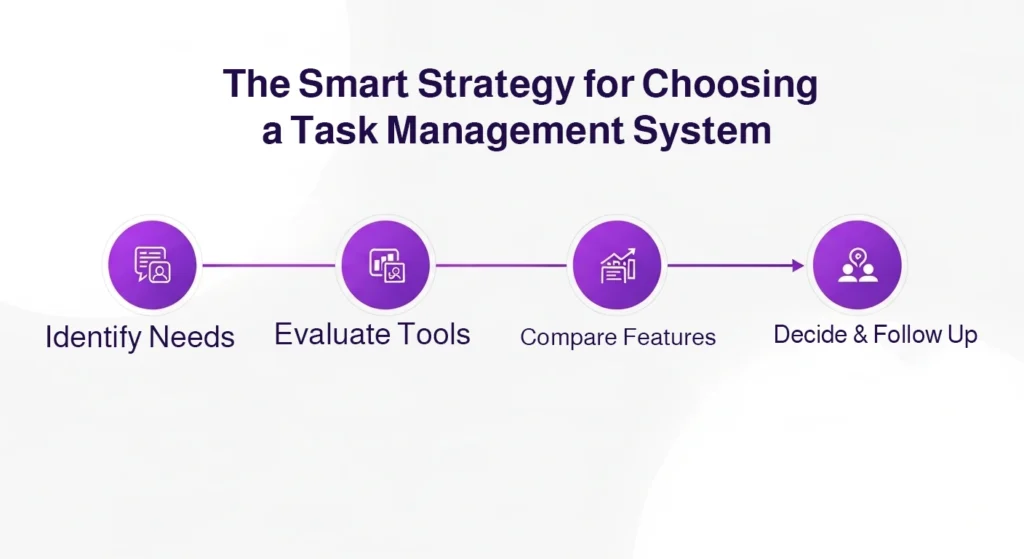
Choosing the right task management system is not just a technical decision—it’s a strategic investment in team efficiency and organizational performance. An integrated system helps structure work, enhance communication, and accurately track progress, ensuring objectives are met on time and with the highest quality.
With a clear plan and advanced digital tools, teams—whether remote or hybrid—can turn daily challenges into opportunities for growth and continuous improvement, fostering a work culture grounded in transparency, collaboration, and shared accountability.
Ultimately, smart and strategic task management goes beyond merely completing work. It creates harmony between people and systems, establishing a flexible, professional, and sustainable productivity environment for the long term.
أحدث المقالات
Recent Posts