
Remote Work vs. Traditional Work in Saudi Arabia: How to Choose the Best for Your Company?
Choosing the right work model has become a crucial factor for any company’s success in Saudi Arabia’s rapidly evolving business environment, where remote work is steadily on the rise. With the spread of modern technologies and shifts in the labor market, understanding the differences between traditional and remote work is essential to determine what suits your company best. This article provides a comprehensive comparison, highlighting the advantages and disadvantages of each model while focusing on local trends and the challenges faced by Saudi businesses.
Understanding Remote Work and Traditional Work
Remote work is a work model that relies on completing tasks and responsibilities outside the company’s premises using digital communication technologies. In contrast, traditional work involves performing professional duties within the company’s office or main headquarters, where face-to-face interactions with colleagues and supervisors are the norm.
The traditional model has a long-standing presence in the Saudi market, fostering a corporate environment that encourages direct meetings and personal interaction. With the ongoing digital transformation in the Kingdom, remote work has become increasingly prevalent, particularly following the launch of Saudi Arabia’s Remote Work Program, which promotes this work style and establishes its legal and regulatory framework.
The Difference Between Traditional and Remote Work
-
With technological advancements and the widespread use of modern communication tools, remote work has become an accessible option for many employees and companies, unlike traditional work, which relies on daily presence in the office. Each of these work models comes with its own advantages and challenges, affecting flexibility, communication, productivity, and work-life balance. The following table highlights the key differences between remote and traditional work to help you better understand each aspect:
| Aspect | Remote Work | Traditional Work |
|---|---|---|
| Location | From home or any place outside the company premises | Within the office or company headquarters |
| Flexibility | High, work hours can be adjusted to employee needs | Limited, usually fixed working hours |
| Communication | Relies on digital tools like Zoom and Slack | Direct, face-to-face interaction with colleagues and managers |
| Productivity | Often higher due to reduced commuting stress and distractions | May be affected by office distractions and daily routines |
| Work Types | Fully remote, hybrid, part-time remote, freelance, project-based | Full-time in-office, shift work, field work |
| Operating Costs | Lower for both company and employees (commuting, facilities, offices) | Relatively higher due to rent, utilities, and services |
| Team Spirit | Lower, requires virtual initiatives to foster engagement | Stronger due to daily interactions and meetings |
| Performance Management | Requires tracking tools like Time Tracking software | Easily monitored through direct presence |
| Work-Life Balance | Better if boundaries are respected | Less flexible, may impact personal balance |
| Employment Opportunities | Wider, can hire talent from different regions | Geographically limited to company location |
| Challenges | Isolation, self-discipline, technical issues | Limited flexibility, higher costs, commuting stress |
Essential Tools and Technologies for Remote and Traditional Work
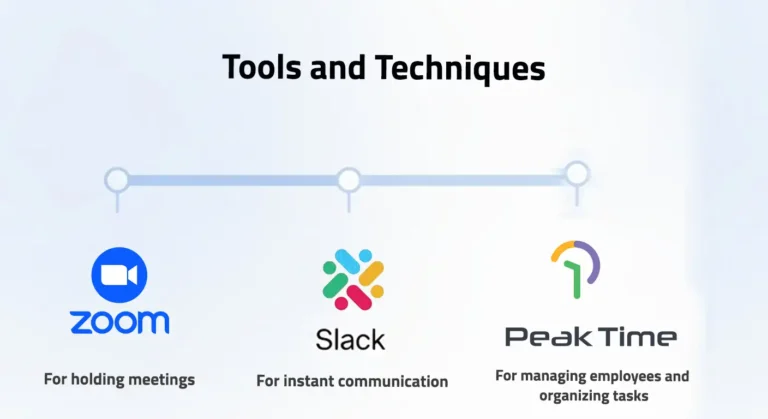
Tools and Technologies Supporting Remote Work
- Virtual Communication and Meetings: Platforms like Zoom, Microsoft Teams, and Google Meet for hosting meetings and sharing screens.
- Project and Task Management: Tools such as Trello, Peak Time, and Monday.com for organizing workflow and tracking progress.
- Instant Messaging: Apps like Slack and Teams for quick exchange of messages and files.
- Cloud Storage: Google Drive, Dropbox, and OneDrive for secure file storage and sharing.
- Cybersecurity: VPNs and network protection solutions to ensure data privacy and security.
- Performance and Productivity Tracking: Tools like Time Doctor and Hubstaff to monitor work hours and analyze performance.
Tools and Technologies Supporting Traditional Work
- Office Communication Systems: Internal phones, fax machines, and direct communication systems.
- Internal IT Infrastructure: Local Area Networks (LAN), desktop computers, and printers to manage daily operations.
- Business Software: ERP systems and databases to support operational management.
- Collaborative Spaces: Meeting rooms, digital bulletin boards, and internal booking systems.
- Attendance Tracking: Biometric or card-based attendance systems.
- Training and Development: On-site workshops to enhance employee skills.
- September 29, 2025
- PeakTime Team
- 2:30 pm
أحدث المقالات
Recent Posts
- Fundamentals of Performance Management: Your Path to Administrative Excellence

- Performance Improvement Plan (PIP): Effective Strategies for Managing Underperformance in Organizations

- Employee Performance Measurement Using Key Performance Indicators (KPIs)

- Employee KPIs: A Strategic Tool to Boost Performance and Foster a Culture of Excellence

- Job Performance Evaluation: Its Role and Importance in Organizational and Employee Development
