
Remote Work in Saudi Arabia 2025: A Complete Guide to the Concept, Benefits, and Management Strategies
Remote work in Saudi Arabia has undergone a significant transformation in recent years. It is no longer just a flexible option that companies turn to when necessary, but has become an essential part of development and digital transformation strategies. With the rapid advancement of modern technologies and the Kingdom’s push to strengthen the digital economy, the remote work model now offers companies a golden opportunity to reduce costs and boost efficiency, while allowing employees to achieve a better work-life balance. Yet, the question remains: can remote work fully replace traditional work patterns, or will it continue to complement them in Saudi Arabia’s modern workplace?
What is the concept of remote work in Saudi Arabia?
Remote work is a modern work model that allows employees to perform their tasks outside the traditional office setting, whether from home or any other location with an internet connection. This model relies on digital tools such as email, instant messaging apps, virtual meetings, and employee and project management platforms.
Remote work is highly flexible, giving employees greater ability to balance their professional and personal lives while maintaining the required productivity levels. In many cases, it can even increase productivity by reducing commuting stress and rigid time constraints.”
Types of Remote Work: From Full-Time to Freelance and Flexible
- Full-Time Remote Work: Allows employees to dedicate themselves entirely to their tasks from any location while maintaining an official relationship with the company.
- Part-Time or Flexible Work: Ideal for those seeking a balance between work and personal life, enabling tasks to be completed at flexible hours without the pressure of full-time attendance.
- Freelance Work: Gives independent workers the freedom to choose projects and clients while enhancing their ability to diversify income sources.
- Temporary Work: Suitable for short-term projects or seasonal tasks, helping companies meet temporary needs without long-term commitments.
- Hourly-Based Work: Focuses on actual output, giving employees the freedom to prioritize quality over traditional working hours.
- Short- and Long-Term Contracts: Provide high flexibility for companies and employees to test employment arrangements or commit for specific periods as needed.
- Platform-Based Work: Makes it easy to access a variety of opportunities quickly, categorized by type of work, required skills, and schedule flexibility.
The evolution of the remote work system in Saudi Arabia
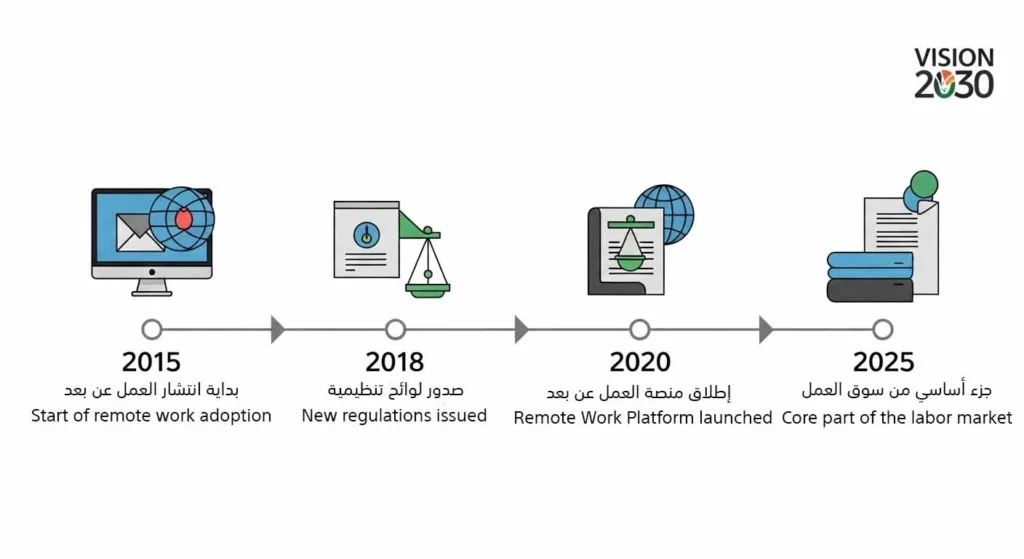
With the launch of Saudi Arabia’s Vision 2030, digital transformation and the promotion of a flexible work environment have become key pillars in developing the labor market. The Kingdom has taken several important steps:
- Legal and Regulatory Framework: The Ministry of Human Resources and Social Development issued regulations governing remote work, outlining the rights and responsibilities of both employees and employers.
- Remote Work Platform: An official platform was established to formalize electronic contracts, providing transparency and legal protection for all parties involved.
- Comprehensive Professional Coverage: The new system allows many professions to be performed remotely, with some exceptions for jobs that require on-site presence or direct handling of equipment or clients.
- Digital Infrastructure Support: Internet and communication services have been enhanced, enabling a more efficient virtual work environment.
- This development has made remote work a strategic option for both companies and individuals, rather than merely an exceptional solution.
What are the fields of remote work in Saudi Arabia?
The fields of remote work in Saudi Arabia are rapidly evolving, driven by digital transformation and the desire of individuals and companies to adopt more flexible work methods. The leading sectors in this domain include technology and programming, digital marketing, customer service, graphic design, translation, and e-learning, all of which rely on digital tools that can be easily managed online.
With this development, new opportunities have emerged in specialized digital roles such as software development, search engine optimization (SEO), digital advertising campaign management, data analysis, remote training, and content writing. These fields are increasingly in demand, opening doors for young professionals and experts to work from anywhere.
In practice, actual job opportunities in the Saudi market include remote graphic designers, online accountants, marketing specialists, application developers, and online customer service representatives.
The Objectives and Advantages of Remote Work in Saudi Arabia
1. Enhancing Flexibility and Boosting Productivity
Allows employees to organize their time according to their personal circumstances.
Reduces fatigue from the office routine and encourages focus.
Provides a calm work environment with the possibility of taking short breaks to recharge.
2. Achieving a Better Work-Life Balance
Makes it easier to balance professional and family commitments.
Reduces psychological stress and fatigue, enhancing family stability.
Improves physical and mental health and increases job satisfaction.
3. Supporting Government Policies and Saudization
Aligns with programs from the Ministry of Human Resources and Social Development.
Opens job opportunities for women and residents in remote areas.
Contributes to increasing Saudization rates and expanding workforce participation.
4. Reducing Operational and Commuting Costs
Cuts office and service expenses for companies.
Saves time, effort, and costs for employees.
Enhances economic efficiency for both organizations and individuals.
5. Additional Benefits for Employees and Companies
Freedom to choose the most suitable work environment and accommodate personal peak hours.
Strengthens the sense of autonomy and mental well-being.
Attracts talent from various regions and supports diversity.
Reduces carbon emissions and promotes environmental sustainability.
Increases employee loyalty and lowers absenteeism and turnover rates.
Challenges and Downsides of Remote Work
1. Social Isolation and Reduced Direct Interaction
- Lack of daily human contact can weaken team spirit and sense of belonging.
- Long-term professional relationships may suffer.
2. Time Management and Self-Discipline Challenges
- Some employees struggle to maintain a consistent routine.
- There is a tendency to procrastinate or have work hours overlap with personal life.
3. Occasional Communication Gaps
- Relying entirely on digital tools can lead to misunderstandings or delayed responses.
- Important non-verbal cues may be lost during virtual meetings.
4. Difficulty Separating Work and Personal Life
- The absence of physical boundaries (office vs. home) can create psychological pressure.
- Informal work hours may increase due to expectations of “constant availability.”
5. Technical Issues
- Poor internet connectivity or power outages can affect performance.
- Continuous need for updated devices and software.
6. Virtual Meeting Fatigue
- Frequent video calls can lead to what is known as “Zoom Fatigue.”
- Concentration and creativity levels may decline over time.
7. Evaluation and Promotion Challenges
- Measuring performance objectively from a distance can be difficult.
- Management may favor on-site employees when making promotion decisions.
Top Strategies for Effectively Managing Remote Work
The success of remote work relies on clear and flexible strategies that ensure productivity, discipline, and the achievement of organizational goals without compromising employee well-being. Here are the most important professional practices:
1. Set Clear and Measurable Goals
Define precise expectations for each employee and team, specifying the desired outcomes.
Align individual goals with organizational objectives to ensure team efforts are integrated.
Use clear performance indicators to track achievements and address any deviations promptly.
2. Enhance Communication and Regular Coordination
Hold periodic meetings to review tasks, discuss challenges, and identify solutions.
Encourage open dialogue among all team members to prevent misunderstandings and potential issues.
Clearly define responsibilities and tasks to ensure smooth coordination.
3. Organize the Team and Allocate Roles
Break large projects into smaller, manageable tasks.
Assign tasks according to each employee’s skills to avoid overlap and ensure quality.
Promote collaboration between different teams to maintain workflow continuity.
4. Monitor Performance and Provide Continuous Feedback
Conduct regular reviews to track achievements and challenges.
Offer constructive feedback to boost performance and motivate employees.
Focus on results and accomplishments rather than just hours worked to ensure high productivity.
5. Support Discipline and Work-Life Balance
Set flexible yet clear work schedules with designated core hours for tasks and meetings.
Encourage short breaks to recharge and maintain focus.
Respect employees’ personal lives to enhance satisfaction and improve performance quality.
6. Build a Strong Remote Team Culture
Foster a sense of belonging and engagement even without physical presence.
Celebrate individual and team achievements to boost morale.
Promote group initiatives and virtual activities to strengthen interaction and collaboration.
7. Leverage Digital Tools for Time and Task Management
Increase Productivity: Tracking time spent on each task helps employees focus, improve performance, and prioritize effectively.
Improve Organization and Task Management: Clear assignment of responsibilities and progress tracking ensures timely project completion.
Enhance Discipline and Commitment: Digital logs guarantee deadlines are met and cultivate a culture of achievement.
Provide Data for Decision-Making: Analyzing time and task data enables management to optimize resource allocation and make strategic decisions.
Best Websites and Platforms to Find Remote Jobs in Saudi Arabia
Successfully finding remote jobs requires knowing the best local and international platforms, as well as understanding how to choose the right site to submit strong applications that increase your chances of being hired.
1. Saudi and International Platforms
Saudi Platforms:
Baaeed: A platform specialized in remote jobs within the Kingdom, covering fields such as technology, marketing, design, and education.
Marn: Offers flexible work opportunities and short- or long-term contracts, with the ability to browse jobs by skill.
Bahr: Combines traditional job listings with remote opportunities, categorized by industry and job level.
International Platforms:
LinkedIn: Allows searching for remote jobs in Saudi Arabia and globally, with options to connect directly with employers.
Upwork & Freelancer: Freelance platforms offering remote opportunities in various fields such as design, programming, and digital marketing.
Indeed & Glassdoor: Provide remote job listings and company reviews to help candidates choose the best options.
- September 24, 2025
- PeakTime Team
- 2:53 pm
أحدث المقالات
Recent Posts
- Fundamentals of Performance Management: Your Path to Administrative Excellence

- Performance Improvement Plan (PIP): Effective Strategies for Managing Underperformance in Organizations

- Employee Performance Measurement Using Key Performance Indicators (KPIs)

- Employee KPIs: A Strategic Tool to Boost Performance and Foster a Culture of Excellence

- Job Performance Evaluation: Its Role and Importance in Organizational and Employee Development
