
Saudization of Jobs in Saudi Arabia 2025: New Decisions and Targeted Sectors
The Saudi labor market is undergoing a profound transformation with the new Saudization decisions for 2025, aimed at increasing national workforce participation and reducing unemployment across the Kingdom. These measures are part of the ambitious national strategy to achieve Vision 2030, which seeks to build a robust economy driven by local talent while minimizing reliance on foreign labor. In this article, we will explore the key new Saudization decisions, the targeted sectors and professions, the expected benefits of these policies, and the support opportunities available for both the public and private sectors.
What is Job Saudization and Why is it Important?
It is a government program and policy designed to increase the employment of Saudi nationals across various labor market sectors, replacing foreign workers with qualified and trained local talent. The program sets mandatory quotas for hiring Saudis in specific professions and sectors according to clear criteria, ensuring that the roles occupied by citizens match their skills, qualifications, and salary expectations. This approach not only creates job opportunities but also enhances performance quality and promotes the sustainability of the national labor market.
The Difference Between Localization and Saudization
Some people may confuse the difference between “localization” and “Saudization,” but the concept is simple. Saudization focuses on quantity—simply increasing the number of Saudi employees in the workforce, regardless of their qualifications or the level of the positions they occupy. Any Saudi can fill a role even if they are not fully qualified, with the main goal being to boost the presence of citizens across all sectors.
Localization, on the other hand, emphasizes quality and suitability. A Saudi employee must be qualified and trained for the position, with consideration given to the job title and salary. The aim is to systematically replace foreign workers with national talent while developing Saudis’ skills to ensure an efficient and sustainable labor market.
In short, Saudization is concerned with the number of Saudi employees, whereas localization focuses on the type of jobs and the level of qualifications, in line with Saudi Arabia’s Vision 2030 to build a sustainable economy driven by local talent.
The Economic and Social Impact of Job Saudization in Saudi Arabia
- Supporting the Local Economy: Job Saudization helps keep spending within the Kingdom, stimulating business activities and supporting national projects.
- Reducing Unemployment: It provides quality job opportunities for Saudi citizens, contributing to lower unemployment rates among the youth.
- Developing National Workforce Skills: Saudization promotes professional training for Saudi employees, enhancing productivity and ensuring a qualified workforce capable of meeting the demands of the modern labor market.
What Are the Key New Decisions for Targeted Professions?
Accounting
Starting in 2025, 40% of accounting positions in establishments with five or more accountants must be filled by Saudis.
This percentage will gradually increase to 70% over five years.
Engineering
30% of positions in technical and engineering roles in establishments with five or more employees must be Saudized, starting July 2025.
Pharmacy
35% of employees in community pharmacies must be Saudis.
65% of pharmacy staff in hospitals must also be Saudized.
Dentistry
45% of dentistry positions in establishments with three or more employees must be filled by Saudis.
This percentage will rise to 55% twelve months after implementation.
A minimum salary of SAR 9,000 has been set for Saudis to be counted toward Saudization quotas.
Human Resources
Saudi nationals will exclusively fill positions such as HR Manager and Chief Administrative Officer, with non-Saudis prohibited from occupying these roles.
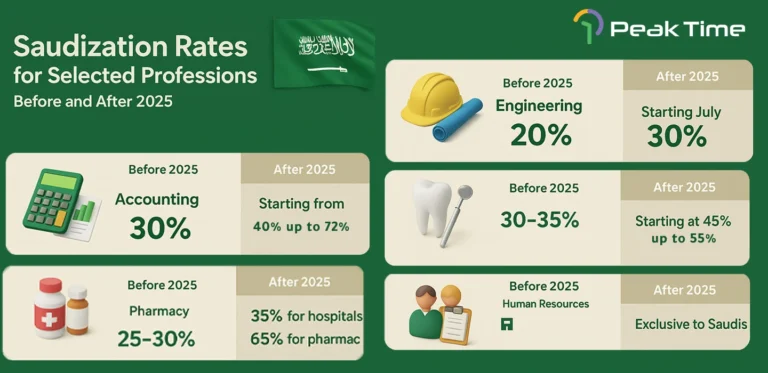
Saudization Opportunities and Challenges in the Saudi Labor Market
Opportunities for Companies and Employees
Improved Productivity: Training and qualifying Saudi nationals enhances overall work quality.
Boosting Investor Confidence: A qualified local workforce attracts investment and strengthens business credibility.
Creating Sustainable Career Opportunities: Supporting Saudi youth in developing their skills increases their employability and income potential.
Temporary Challenges
Higher Operational Costs: Due to the need for training programs.
Skills Gaps: Some sectors face a shortage of technical and specialized skills.
Resistance in Certain Sectors: Industries traditionally reliant on foreign labor may be slow to adapt.
Government Support Programs for Beneficiaries
Tawteen Program (HRDF):
Financial Incentives: Establishments receive monetary incentives when employing Saudi nationals with a minimum salary of SAR 5,000.
Training Programs: Support includes training initiatives such as “Tamheer” and “HRDF” programs to develop job seekers’ skills.
Employment Facilitation: The government provides streamlined hiring procedures through the national portal, “Taqat.”
Monitoring and Penalties:
Fines: Imposed on establishments that fail to meet Saudization quotas.
Suspension of Government Services: Applied to non-compliant establishments to ensure adherence to the regulations.
Integrating Remote Work and the Saudi Remote Work System into Saudization
Saudization decisions also cover remote work professions, which are implemented according to the Saudi Remote Work Program Requirements include having a formal employment contract, registration in the social insurance system, and adherence to the minimum wage to ensure that the employee counts toward Saudization quotas. The government supports the employment of Saudis through specialized training programs, continuous technical assistance, and digital platforms such as the “Remote Work Platform” and “Taqat” to facilitate the placement of national talent in these opportunities.
Remote work enables the employment of Saudis across different regions of the Kingdom and supports specific groups, including women and people with disabilities, while reducing operational costs for establishments. Saudi Arabia also aims to employ artificial intelligence and digital monitoring technologies to enhance the efficiency of Saudization and remote work implementation.
The Saudization decisions for 2025 represent a strategic step toward building a sustainable work environment based on qualified national talent. Saudization not only creates new job opportunities but also enhances the Kingdom’s economic and social performance, while boosting the productivity of local companies and establishments.
Saudization offers a real opportunity for Saudi youth to access competitive and stable jobs, and for businesses to strengthen a qualified national workforce and increase investor confidence. Additionally, training and qualification programs support the development of technical and professional skills in line with the demands of the modern labor market.
أحدث المقالات
Recent Posts
- Fundamentals of Performance Management: Your Path to Administrative Excellence

- Performance Improvement Plan (PIP): Effective Strategies for Managing Underperformance in Organizations

- Employee Performance Measurement Using Key Performance Indicators (KPIs)

- Employee KPIs: A Strategic Tool to Boost Performance and Foster a Culture of Excellence

- Job Performance Evaluation: Its Role and Importance in Organizational and Employee Development
